

News
Old termite mounds help support high insect biodiversity in tropical rainforests
Centre for Biodiversity and Sustainability26 June 2025


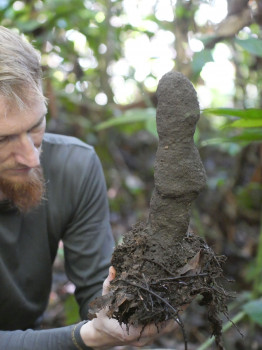
Lead author Jiri Tuma with a Dicuspiditermes termite mound.
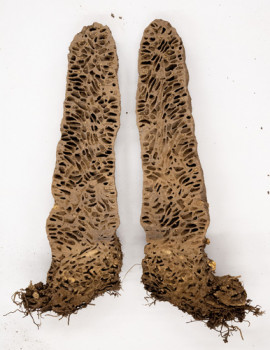
Internal structure of a Dicuspiditermes termite mound showing the spaces that are inhabited by a range of other animals once the mound is no longer occupied.
Imagine wandering through the lush Bornean rainforest, past towering trees and vibrant foliage. You might not give a second thought to termite mounds scattered across the forest floor. But what if we told you these seemingly unassuming structures are bustling metropolises for insects, even long after their original inhabitants have moved on?
That's precisely what a new study, co-authored by Dr Tom Fayle, has revealed! Published in Soil Ecology Letters, the research uncovered that abandoned termite mounds are critical microhabitats, teeming with diverse insect life, particularly ants, in both untouched and previously logged rainforests.
Dr Fayle, Dr Kalsum M. Yusah of the Royal Botanic Gardens, Kew, and Dr Jiří Tůma of the Biology Centre of the Czech Academy of Sciences, discovered that these unoccupied mounds can host five to nine times more invertebrates than the surrounding soil. This means hundreds of thousands of insects per hectare are finding refuge and thriving in these 'ghost towns' of the termite world! This incredible finding challenges our understanding of rainforest biodiversity and highlights the often-overlooked role of "ecosystem engineers" like termites.
Find out more about this remarkable discovery on the main QMUL website: lnkd.in/et7VBrUn
Or dig into the paper here: lnkd.in/e5c8PFxX
People: Tom FAYLE
Contact: Tom FayleEmail: t.fayle@qmul.ac.uk
Updated by: Tom Fayle