

News
Applied Algebra and Geometry Network Meeting Report
Centre for Combinatorics, Algebra and Number Theory2 October 2025


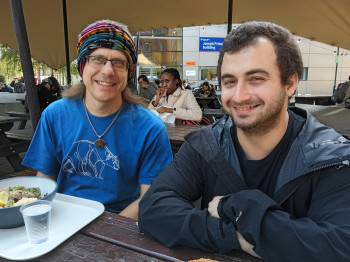
Dante Luber (right) with Alex Fink
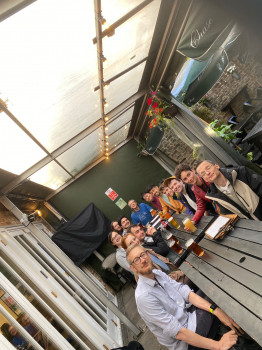
Meeting participants
The School of Mathematical Sciences hosted the twenty-second meeting of the Applied Algebra and Geometry Network on Monday 15 September with a large contingent from the Centre for Combinatorics, Algebra and Number Theory participating.
Queen Mary postdoc Dante Luber shared his thoughts after the meeting.
What were your general impressions of the conference?
All of the speakers made an effort not to assume too much background knowledge, and the material was presented in an accessible way. The talks were given at a relaxed pace and the speakers were receptive to questions. Between talks, there was a generally talkative atmosphere. There were lots of opportunities to catch up with people I already knew, and meet more people from the UK algebraic geometry community.
How do you feel it has helped your research?
The first talk [Primoz Skraba (QMUL), "Geometry and (Co)Homology Computation"] concerned cohomology computations. Cohomology has been coming up in my more recent research, and I am always interested in ways direct computation can be involved. Furthermore, it was interesting to hear about the algorithms the speaker introduced. I am curious if these could (or maybe have already been) implemented in software systems such as OSCAR. The second talk also touched on areas related to my work, as it considered group actions on algebraic varieties and the associated representation theory. The last talk concerned cryptography in tropical geometry. While my work in tropical geometry does not relate to cryptography, it was cool the broad range of problems the area can be applied to.
If an undergraduate wanted to attend the conference, what advice would you give them?
I would say that the most important part of any talk for a non-expert is the first half or so, where the speaker introduces the fundamental concepts and background which are prerequisite to understand their results. Don't worry about understanding all the details during the talk, but take notes on the big picture and key words. Later, you can go over those notes and find resources to fill in the details. Don't be afraid to approach the speakers between the talks to ask questions less to their results. I think it's perfectly fine to ask a speaker "what's a good resource if I wanted to learn about X", where X is a topic that came up in their talk. Also, there's no harm in asking a speaker to send you their slides. In fact, I did this for one of the talks at this meeting.
Take a look at the Applied Algebra and Geometry Network website to find out more, including details of upcoming meetings and how to sign up for their newsletter.
People: Alex FINK Primoz SKRABA
Contact: Dante LuberEmail: d.luber@qmul.ac.uk
Updated by: Robert Johnson