

News
Professor Federico Ardila joining QMUL in January 2026
Centre for Combinatorics, Algebra and Number Theory11 December 2025


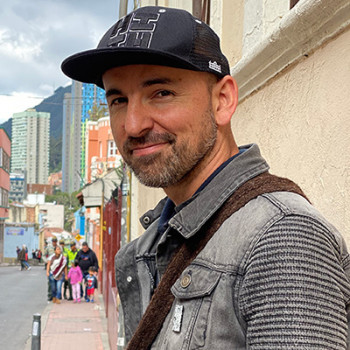
Prof. Federico Ardila (Photo credit: May-Li Khoe)
Prof. Federico Ardila will be joining the School of Mathematical Sciences, QMUL in January 2026 as part of the Faculty of Science and Engineering Talent scheme. Ardila is a Colombian mathematician whose work in matroid theory lies at the intersection of combinatorics with geometry, algebra, topology, and applications.
Apart from his research, Prof. Ardila is also widely known for his efforts to make the mathematical community more just, more equitable, and more welcoming, and for a set of of axioms that attempt to encapsulate these efforts.
Among many possibilities, some highlights from his mathematical career include:
- Work with Klivans which gives a combinatorial description of the Bergman fan, providing new geometric insights into this fundamental object from algebraic geometry. This also led to a connection between these objects and phylogenetics, which has driven several important advances in algorithms for reconstructing phylogenies in mathematical biology.
- His contributions at the forefront of the revolution in modern matroid theory instigated by June Huh (2022 Fields medalist). In work with Denham and Huh he extended and strengthened the Hodge theoretic approach in ways that both answered two open problems from the 1980s and has allowed later work to use many different geometries, not only the 'wonderful compactification' that Huh employed.
- In 2022 he was an invited speaker at the International Congress of Mathematicians (the largest and most prestigious mathematics conference).
- He created and ran the SFSU–Colombia Combinatorics Initiative which through his innovative approach to graduate education launched many students into research. This scheme embodies his approach to diversify mathematics and resulted in a whole generation of Colombians working as early- to mid-career researchers worldwide as well as a very healthy combinatorics community inside the country.
We look forward to Federico enriching Queen Mary with his mathematical expertise and his approach to doing mathematics.
Ardila's Axioms
Axiom 1. Mathematical potential is distributed equally among different groups, irrespective of geographic, demographic, and economic boundaries.
Axiom 2. Everyone can have joyful, meaningful, and empowering mathematical experiences.
Axiom 3. Mathematics is a powerful, malleable tool that can be shaped and used differently by various communities to serve their needs.
Axiom 4. Every student deserves to be treated with dignity and respect.
You can find out more about Federico and his research on his website: https://fardila.com
Federico is also a regular contributor to the Numberphile project. You can find his contributions here:
https://www.numberphile.com/videos/category/Federico+Ardila
Or, for something more technical, his ICM talk and survey article "The geometry of geometries: matroid theory, old and new" is available to watch: https://www.youtube.com/watch?v=mrnB-SYaHZE
or read: https://arxiv.org/abs/2111.08726
Email: r.johnson@qmul.ac.uk
Updated by: Robert Johnson