

News
Welcome to Peter McNamara
Centre for Combinatorics, Algebra and Number Theory24 September 2026


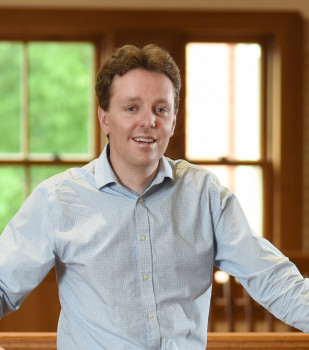
Peter McNamara
We are pleased to be hosting Peter McNamara for a year-long visit as part of his sabbatical from Bucknell University.
We asked him to tell us a bit about himself and his work.
Tell us about your academic journey so far.
Following undergrad at Trinity College Dublin, I did my Ph.D. at Massachusetts Institute of Technology. Both Federico Ardila and I had Richard Stanley as our advisor and graduated in 2003. After postdocs at Université du Québec à Montréal and at Instituto Superior Técnico in Lisbon, I joined Bucknell University in central Pennsylvania in 2006, and was promoted to full professor in 2017.
What are you hoping to get out of your visit to Queen Mary?
There's nobody else at Bucknell who does discrete math, so I'm looking forward to interacting with Centre members with overlapping interests. There is also great potential here for exploring avenues that are mostly new to me, especially tropical geometry and matroid theory. More broadly, I'm hoping to expand my network in the London area and in the UK in general. Overall, it's exciting to be able to devote so much time to research, something that gets very little of my time during a normal semester.
What general area is your research in?
Algebraic combinatorics, typically with more emphasis on the combinatorics side of this field. I've done projects focussed on partially ordered sets, bijective combinatorics, and, most extensively, symmetric and quasisymmetric functions. For the algebra of symmetric functions, the most studied basis is the Schur functions, due to their beautiful combinatorial definition in terms of Young tableaux, and because they arise in other areas of pure mathematics, including representation theory, Schubert calculus, and eigenvalues of matrices. Over the years, Schur functions have been extended in many directions but perhaps the simplest generalisation are the skew Schur functions. The skew Schur functions are too numerous to form a basis, and I've written several papers examining the relations among skew Schur functions.
And could you tell us something about a specific problem you have worked on?
The Schur functions can be indexed by Young diagrams, and the skew Schur functions are indexed by skew Young diagrams. Is there a way to tell if two skew Schur functions are equal just by looking at their skew Young diagrams? Stephanie van Willgenburg and I devised the first conjectural necessary and sufficient conditions for two skew Young diagrams to yield the same skew Schur function. We proved one half of the sufficiency direction, and the other half was recently completed by Nick Olson-Harris; the necessary direction is wide open.
What do you enjoy most about your area of maths?
I like that it's often easy to get to concrete questions without knowing too much background. Many of the questions I study are amenable to conjecture generation and testing by computer. These two aspects, besides appealing to me, also make my area accessible to advanced undergraduates.
What are your interests outside maths?
Cycling, including optimizing my route to and from work among many choices. I spend an inordinate amount of time traveling to and watching my daughters' (aged 9 and 15) football trainings and practices, and I'm getting to know the suburbs of London quite well!
On some other personal notes, my wife, Emily Dryden, works in spectral geometry and geometric analysis, and is spending the year at King's. By now, we've met people at work, schools and football, and have been impressed at how welcoming and accommodating everyone has been.
People: Federico ARDILA Alex FINK
Updated by: Robert Johnson