

News
The School of Physical and Chemical Sciences welcomes global physics community for Amplitudes 2026
Centre for Theoretical Physics and Astronomy6 July 2026


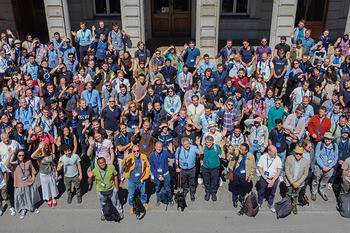
Group photo at Amplitudes 2026
Researchers from around the world gathered at Queen Mary University of London from 29 June to 3 July 2026 for Amplitudes 2026, one of the leading international conferences in theoretical high-energy physics.
The five-day event welcomed some 225 delegates from about 20 countries and nearly 100 institutions across Europe, the Americas and Asia, with the largest contingents travelling from the UK, USA, Germany and China.
The conference focused on scattering amplitudes, mathematical quantities that describe how particles interact. These calculations underpin many of the world's most important experiments in fundamental physics, including those carried out at the Large Hadron Collider at CERN, as well as the modelling of gravitational waves produced by colliding black holes.
David Kosower (IPhT, CEA-Saclay) opened the conference with a lecture on scattering amplitudes for gravitational waves, and invited speakers included Nima Arkani-Hamed (Institute for Advanced Study, Princeton). Throughout the week, researchers presented advances in the mathematical structures that underpin scattering amplitudes, including positive geometries such as the amplituhedron, and cluster algebras. They also unveiled exceptionally precise new predictions for particle collider experiments and gravitational-wave observations, alongside new ideas in cosmology, such as methods for computing cosmological correlators, which could deepen our understanding of the early Universe.
A particular highlight of the conference was a special discussion titled "Amplitudes before Amplitudes", bringing together four pioneers of the field: Zvi Bern (University of California, Los Angeles), Lance Dixon (SLAC National Accelerator Laboratory/Stanford University), David Dunbar (Swansea University) and David Kosower. The panel reflected on their work computing scattering amplitudes in the 1990s, before Edward Witten's landmark 2003 twistor paper transformed the subject and sparked the modern boom from which the Amplitudes series grew.
The discussion showed how far the field has come in a generation. When Queen Mary first hosted the conference in 2010, just 54 delegates attended. This year's meeting attracted more than four times that number, demonstrating the increasing importance of scattering amplitudes across both mathematics and physics.
Running annually since 2009, the Amplitudes series is the main meeting of the international scattering amplitudes community. Queen Mary is the first institution to host the conference twice, reflecting its international reputation in this area of research.
The conference was organised by Andreas Brandhuber, Ricardo Monteiro, Gabriele Travaglini, Congkao Wen and Chris White of Queen Mary's Centre for Theoretical Physics and Astronomy, one of the world's leading amplitudes groups.
Amplitudes 2026 was supported by the legacy of SAGEX (Scattering Amplitudes: from Geometry to Experiment), a Marie Skłodowska-Curie Innovative Training Network funded by the European Commission and led by Queen Mary. The network brought together researchers across Europe to advance the development and application of scattering amplitude methods, helping to strengthen the international collaborations celebrated at this year's conference.
Updated by: Gabriele Travaglini