

News
New drug discovery approach opens the door to targeting previously "undruggable" RAB27A/B protein
Centre for Molecular Cell Biology3 August 2026


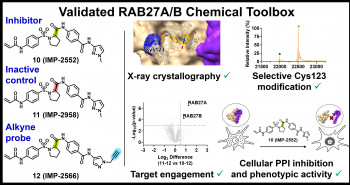
Graphical abstract
Dr Elena De Vita from our Centre for Molecular and Cell Biology has led a study that was recently published in the Journal of the American Chemical Society. The work developed a new class of chemical compounds that can target RAB27 proteins - challenging targets that have previously been considered difficult or impossible to tackle with conventional drug discovery approaches.
RAB27 proteins play important roles in controlling the trafficking of materials within cells, mechanisms which can be rewired in cancer and other diseases. However, like many small GTPases, RAB27 lacks the conventional binding pockets that medicinal chemists typically exploit to develop drugs. Its interactions with other proteins are also difficult to disrupt using small molecules.
The research team overcame these challenges using a cutting-edge drug discovery approach known as targeted covalent inhibition. By identifying a previously underexploited site on RAB27, the researchers developed compounds that selectively bind to the protein and disrupt its interactions with partner proteins thus stopping cellular trafficking. The resulting chemical probes are active in living cells, thus providing researchers with validated tools to investigate RAB27 biology and determine whether this challenging protein could represent a future therapeutic target. As part of their commitment to developing high-quality chemical probes for the scientific community, the researchers also investigated a previously reported RAB27 probe, Nexinhib-20, which had been proposed as a selective inhibitor of RAB27. Their studies found that Nexinhib-20 exhibited substantial non-selective reactivity and cellular toxicity at concentrations commonly used in biological experiments, raising important questions about its suitability as a tool for studying RAB27.
Overall, the work demonstrates the potential of covalent chemistry to expand the range of proteins that can be targeted by medicines, opening new opportunities for drug discovery against disease-associated proteins that have traditionally been considered "undruggable".
Email: e.devita@qmul.ac.uk
Updated by: Elena De Vita