

News
New study proposes an information theory framework for mining higher-order triadic interactions in complex biological systems
Centre for Complex Systems5 January 2026


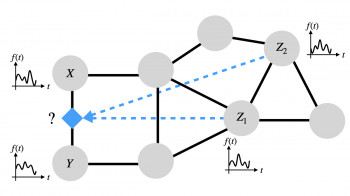
Triadic interactions—higher-order interactions in which one node regulates the interaction between two others—are widespread in complex systems, from gene-regulatory and metabolic networks to neuroscience and climate. For example, the presence or absence of an enzyme can affect the reactivity between two chemicals. Likewise, in the brain, glia cells can regulate synaptic connections between two neurons. Yet, despite their importance, methods for detecting such interactions directly from dynamical data have been largely absent.
In a new study published in Nature Communications, an international team of scientists led by Ginestra Bianconi, Professor of Applied Mathematics in the Centre for Complex Systems (CCS, QMUL), propose a new information-theory framework for mining triadic interactions in real-world biological systems. The authors first introduce the Triadic Perceptron Model, which captures the dynamics that arise in the presence of triadic interactions. By demonstrating that triadic interactions generate a distinct dynamical signature detectable through the proposed information-theoretic framework, the model lays the foundation for the authors' development of the Triadic Interaction Mining (TRIM) algorithm. The wide applicability of this algorithm to real-world scenarios is demonstrated by identifying new candidate triadic interactions relevant to Acute Myeloid Leukaemia from gene-expression data.
Marta Niedostatek, the CCS PhD student who is joint first author of this study, together with a former CCS postdoc Anthony Baptista, states: "Triadic interactions are often overlooked in the study of complex systems, yet they are ubiquitous. Detecting their presence enhances our understanding of complex biological dynamics and can open new perspectives across different scientific domains."
Given the ubiquity and importance of triadic interactions in complex systems, these new methods promise exciting opportunities for detecting such connections from real-world data and exploiting this knowledge to understand and control systems across various domains including biology, neuroscience, and climate.
Link to the original research article: M. Niedostatek et al., Mining higher-order triadic interactions, Nat. Commun. 16, 11613 (2025)
People: Ginestra BIANCONI
Contact: Ginestra BianconiEmail: g.bianconi@qmul.ac.uk
Updated by: Lennart Dabelow