

News
Centre members contribute to ECDC assessment of newborn RSV immunisation in Europe
Centre for Complex Systems3 November 2026


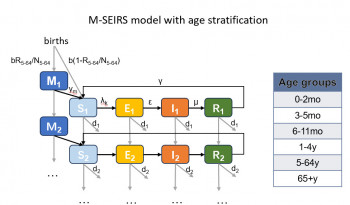
Illustration of the model contributed by Yuhan Li and Nicola Perra from the Centre for Complex Systems.
Yuhan Li, PhD student in the Centre for Complex Systems, and her supervisor Nicola Perra, Reader in Applied Mathematics, were among the international modelling teams contributing to a new assessment by the European Centre for Disease Prevention and Control (ECDC) of how universal immunisation of newborns against respiratory syncytial virus (RSV) could reduce infant hospitalisations across the EU/EEA.
RSV is a major cause of respiratory infections in Europe, accounting for approximately 250,000 hospital admissions per year in the EU/EEA, with newborns having the highest per-capita rate of RSV hospitalisation. With long-acting monoclonal antibodies (la-mAbs) and a maternal vaccine (MV) now authorised in the EU, countries are deciding whether and how to introduce them into national programmes. To inform these decisions, ECDC used RespiCompass, its European scenario modelling hub for respiratory diseases, to compare the two options across 28 EU/EEA countries. Ten independently developed models, spanning static, dynamic transmission, and agent-based approaches, were run on common scenarios of high and low immunisation coverage. The QMUL team specifically contributed with a detailed age-structured compartmental model featuring demographic dynamics and seasonality.
All models indicate that both strategies would substantially reduce RSV hospitalisations in infants, with la-mAbs performing slightly better than MV. At high coverage (90%), la-mAbs are projected to avert on average 61% of hospitalisations among infants aged 0–2 months, compared to 52% for MV. The benefit grows almost linearly with coverage and is concentrated in the first months of life, which highlights the importance of reaching newborns early and at scale. While the models differ in the size of the projected impact, they agree on this overall picture.
The assessment gives national health authorities a common, multi-model evidence base for planning RSV immunisation programmes, including country-specific estimates of how many newborns need to be immunised to prevent one hospitalisation. The authors stress that the results do not include programme costs, which differ considerably between the two products, and should therefore be considered alongside cost-effectiveness analyses. The projections are broadly consistent with early real-world evidence from countries that have already introduced universal RSV immunisation.
Link to the original report: ECDC, Multi-model assessment of the impact of newborn RSV immunisation on hospitalisation burden in the EU/EEA (Stockholm, 28 October 2026)
Link to the ECDC news item: As the cold season nears, universal immunisation of newborns against RSV could significantly reduce infant hospitalisations across Europe
People: Nicola PERRA
Contact: Lennart DabelowEmail: l.dabelow@qmul.ac.uk
Updated by: Lennart Dabelow