

News
New framework to measure fairness in epidemic models published in Nature Communications
Centre for Complex Systems9 November 2026


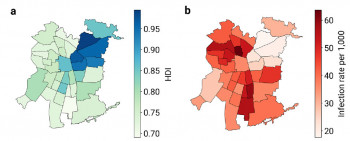
Human Development Index (HDI, a) and COVID-19 infection rates (b) in each "comuna" of Santiago de Chile.
A new study by Yuhan Li, PhD student in the Centre for Complex Systems, her supervisor Nicola Perra, Reader in Applied Mathematics, and colleagues from Italy proposes a systematic way to quantify the fairness of computational epidemic models. The paper is entitled "Fairness in infectious disease modeling" and was published in Nature Communications.
Epidemic models strongly influence public health policy, and the COVID-19 pandemic showed that infectious diseases do not affect all groups equally. Fairness has been studied extensively in machine learning, but computational epidemiology has lacked a commonly agreed definition. Drawing on Social Epidemiology, the authors define a model as fair if it accurately captures the observed (un)equal distribution of disease burden across groups defined by equity-related features such as age, ethnicity or neighbourhood. They distinguish this property of a model from health equity, the normative goal that interventions informed by models should pursue. The framework provides three metrics, for ordered groups (such as age or income), unordered groups (such as ethnicity) and spatially structured populations.
The researchers apply their metrics to a range of modelling approaches and case studies, including COVID-19 in London, New York City and Santiago de Chile, the 2016 Zika outbreak in Colombia, and an agent-based model of New York City. The results show that fairness does not simply follow from model complexity or goodness of fit. Adding more detailed contact structure does not necessarily make a model fairer, whereas ingredients such as age-dependent mortality or human mobility data can substantially improve how well a model captures observed inequalities.
The study also shows how fairness can inform decisions. In a stylised second-wave scenario for New York City, using the fairness measures to guide vaccine allocation gave the largest reduction in deaths overall while improving outcomes in every racial and ethnic group. By contrast, allocation based on observed death rates alone benefited minority groups but left the White majority worse off than under allocation proportional to population size. The authors stress that the scenario is hypothetical and does not capture practical constraints such as logistics or vaccine hesitancy. They also propose a simple workflow for modellers: compare fairness scores across candidate models, identify which subgroups are misrepresented, and design interventions with fairness-validated models.
Link to the original research article: Y. Li, N. Gozzi, N. Perra and M. Tizzoni, Fairness in infectious disease modeling, Nat. Commun. (2026)
People: Nicola PERRA
Contact: Lennart DabelowEmail: l.dabelow@qmul.ac.uk
Updated by: Lennart Dabelow