Research
Airway Biology, Cilia/ centrosome/ ciliopathies, In vitro airway models, Asthma/ COPD, Volume EM, Super-resolution microscopy
Interests
My research sits at the interface of airway cell biology, organelle biophysics, and advanced imaging, with the overarching goal of understanding how the molecular and three-dimensional architecture of the respiratory epithelium governs lung function in health and disease.
A central focus of the laboratory is the biology of cilia and centrosomes in the human airway. Using super-resolution fluorescence microscopy and volume electron microscopy (volume EM), we have mapped the nanoscale organisation of basal bodies, basal feet, and the pericentriolar material, revealing structural principles that underpin cilia assembly, beating coordination, and epithelial defence. This work has direct translational relevance to motile ciliopathies, including Primary Ciliary Dyskinesia (PCD), for which we developed quantitative super-resolution pipelines to improve molecular diagnosis (Science Translational Medicine, 2020; Developmental Cell, 2020).
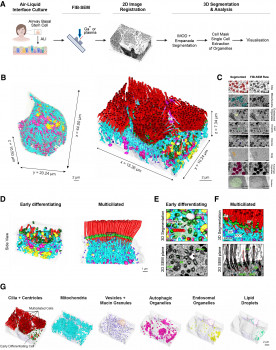
More recently, the laboratory has expanded into the 3D nanoscale architecture of the respiratory epithelium as a whole, employing focused ion beam-SEM to reconstruct multiciliated airway cells in their full ultrastructural context. This has uncovered previously unrecognised organellar relationships, including a motile cilia–rootlet–mitochondria communication axis, with implications for understanding how ciliary beat is energetically sustained and how it is disrupted in chronic airway disease (Cell Reports, 2026).
A parallel research strand addresses common lung conditions — asthma, COPD, and respiratory toxicity — using physiologically relevant in vitro airway models that recapitulate the mucociliary epithelium. These models serve as platforms to interrogate disease mechanisms (Nature Genetics, 2021) and to assess the impact of environmental pollutants, chemicals, and drugs on airway cell biology, including ongoing work supported by industrial partnerships with Astra Zeneca to investigate mechanisms of new drug modalities (ASOs) toxicity and Syngenta on New Alternative Methodologies (NAMs) for respiratory toxicity prediction.
Methodological innovation is integral to the group's identity. We develop and apply AI-assisted 3D segmentation workflows for volume EM datasets, quantitative image analysis tools, and structured illumination microscopy approaches to extract biological insight from complex, high-dimensional imaging data.
Together, these research strands position the laboratory at the intersection of fundamental cell biology, rare disease, chronic respiratory disease, and imaging technology — contributing to the Centre's strengths in molecular and cellular mechanisms of human health and pathology.
Publications of specific relevance to the Centre for Molecular Cell Biology

Publications of specific relevance to the Centre for Molecular Cell Biology
2026
 Volume EM reveals desmosome three-dimensional architecture in epithelial cells and tissue models
Bharathan NK Giang W Chen EC Zimmer SE Lhamo S Jorgens DM Inman JL Mennella V et al.
Journal of Cell Biology,
Rockefeller University Press vol. 225 (10)
05-08-20263D nanoscale reconstruction of human airway multiciliogenesis reveals cellular architecture remodeling and cilia-mitochondria link via rootletsVijayakumaran A Godbehere C Abuammar A Breusegem SY Hurst LR Morone N Llodra J Dalbay MT et al.
Cell Reports,
Elsevier vol. 45 (7)
01-07-2026 Loss of RPGR disrupts motile cilia and causes primary ciliary dyskinesia by affecting F-actin dynamicsWu Y Tavares E Liang B Wee WB Mennella V Feng H-C Cao J Wong PY et al.
Journal of Clinical Investigation,
American Society For Clinical Investigation vol. 136 (10)
31-03-2026 2024
ARL13B controls male reproductive tract physiology through primary and Motile CiliaAugière C Campolina-Silva G Vijayakumaran A Medagedara O Lavoie-Ouellet C Joly Beauparlant C Droit A Barrachina F et al.
Communications Biology,
Springer Nature vol. 7 (1)
14-10-2024 Uncovering structural themes across cilia microtubule inner proteins with implications for human cilia functionAndersen JS Vijayakumaran A Godbehere C Lorentzen E Mennella V Schou KB
Nature Communications,
Springer Nature vol. 15 (1)
27-03-2024 DPCD is a regulator of R2TP in ciliogenesis initiation through Akt signalingMao Y-Q Seraphim TV Wan Y Wu R Coyaud E Bin Munim M Mollica A Laurent E et al.
Cell Reports,
Elsevier vol. 43 (2)
01-02-2024 PrefaceMennella V
Methods in Molecular Biology vol. 2725
01-01-2024 2023
Airway Cells 3D Reconstruction via Manual and Machine-Learning Aided Segmentation of Volume EM DatasetsVijayakumaran A Abuammar A Medagedara O Narayan K Mennella V
Methods in Molecular Biology,
Springer Nature vol. 2725, 131-146.
20-10-2023 A Novel Sandwich Method for Serial Block Face SEM Imaging of Airway Multiciliated EpitheliumMorone N Martin MG Goggin P Czymmek KJ Mennella V Gonzalez JL
Methods in Molecular Biology,
Springer Nature vol. 2725, 121-129.
20-10-2023 Structured Illumination MicroscopyMennella V
In
Encyclopedia of Cell Biology,
Elsevier 105-121.
01-01-2023 2022
Hereditary Mucin Deficiency Caused by Biallelic Loss of Function of MUC5BCostain G Liu Z Mennella V Radicioni G Goczi AN Albulescu A Walker S Ngan B et al.
American Journal of Respiratory and Critical Care Medicine,
Oxford University Press (OUP) vol. 205 (7), 761-768.
01-04-2022 Primary Ciliary DyskinesiaMennella V Jackson CL Driessens C Horton KL Lucas JS
In
Encyclopedia of Respiratory Medicine,
Elsevier 188-207.
01-01-2022 Nanometer-Scale Molecular Mapping by Super-resolution Fluorescence MicroscopyMennella V Liu Z
In
Fluorescent Microscopy,
Springer Nature 305-326.
01-01-2022 2021
Whole genome sequencing in the diagnosis of primary ciliary dyskinesiaWheway G Thomas NS Carroll M Coles J Doherty R Goggin P Green B Harris A et al.
Bmc Medical Genomics,
Springer Nature vol. 14 (1)
23-09-2021 A novel short isoform of ACE2 is expressed in ciliated airway epithelium and is induced by interferon and rhinovirus infection but not SARS-COV-2; implications for COVID-19 interferon treatmentJackson CL Blume C Spalluto CM Mc Cormick CJ Davies DE Lucas JS Mennella V Wheway G
Airway cell biology and immunopathology.
05-09-2021 A novel ACE2 isoform is expressed in human respiratory epithelia and is upregulated in response to interferons and RNA respiratory virus infectionBlume C Jackson CL Spalluto CM Legebeke J Nazlamova L Conforti F Perotin J-M Frank M et al.
Nature Genetics,
Springer Nature vol. 53 (2), 205-214.
11-01-2021 2020
Comparative Super-Resolution Mapping of Basal Feet Reveals a Modular but Distinct Architecture in Primary and Motile CiliaNguyen QPH Liu Z Albulescu A Ouyang H Zlock L Coyaud E Laurent E Finkbeiner W et al.
Developmental Cell,
Elsevier vol. 55 (2), 209-223.e7.
01-10-2020 Super-Resolution Microscopy and FIB-SEM Imaging Reveal Parental Centriole-Derived, Hybrid Cilium in Mammalian Multiciliated CellsLiu Z Nguyen QPH Nanjundappa R Delgehyr N Megherbi A Doherty R Thompson J Jackson C et al.
Developmental Cell,
Elsevier vol. 55 (2), 224-236.e6.
01-10-2020 Hereditary Mucin Deficiency Caused by Biallelic Loss-of-Function of MUC5B Defines a Novel Category of Lung DiseaseLiu Z Costain G Goczi A Albulescu A Walker S Ngan B Hall DA Marshall CR et al.
C49. PEDIATRIC CYSTIC FIBROSIS, PCD, AND COUGH. vol. 201 (Supplement_1), a5353-a5353.
01-05-2020 Author Correction: Sas-4 provides a scaffold for cytoplasmic complexes and tethers them in a centrosomeGopalakrishnan J Mennella V Blachon S Zhai B Smith AH Megraw TL Nicastro D Gygi SP et al.
Nature Communications,
Springer Nature vol. 11 (1)
15-04-2020 A quantitative super-resolution imaging toolbox for diagnosis of motile ciliopathiesLiu Z Nguyen QPH Guan Q Albulescu A Erdman L Mahdaviyeh Y Kang J Ouyang H et al.
Science Translational Medicine,
American Association For The Advancement of Science (Aaas) vol. 12 (535)
18-03-2020 2019
Quantitative High-Speed Video Profiling Discriminates between DNAH11 and HYDIN Variants of Primary Ciliary DyskinesiaChioccioli M Feriani L Nguyen Q Kotar J Dell SD Mennella V Amirav I Cicuta P
American Journal of Respiratory and Critical Care Medicine,
Oxford University Press (OUP) vol. 199 (11), 1436-1438.
01-06-2019 Quantitative High Speed Video Profiling Discriminates Between Variants of Primary Ciliary DyskinesiaChioccioli M Feriani L Nguyen Q Kotar J Dell SDM Mennella V Amirav I Cicuta P
D18. BEST OF NOVEL TECHNOLOGIES AND METHODOLOGIES. vol. 199 (Supplement_1), a5883-a5883.
01-05-2019 2018
PPP1R35 is a novel centrosomal protein that regulates centriole length in concert with the microcephaly protein RTTNSydor AM Coyaud E Rovelli C Laurent E Liu H Raught B Mennella V
,
Elife vol. 7
31-08-2018 Author Correction: A novel atypical sperm centriole is functional during human fertilizationFishman EL Jo K Nguyen QPH Kong D Royfman R Cekic AR Khanal S Miller AL et al.
Nature Communications,
Springer Nature vol. 9 (1)
13-07-2018 Acyldepsipeptide Analogs Dysregulate Human Mitochondrial ClpP Protease Activity and Cause Apoptotic Cell DeathWong KS Mabanglo MF Seraphim TV Mollica A Mao Y-Q Rizzolo K Leung E Moutaoufik MT et al.
Cell Chemical Biology,
Elsevier vol. 25 (8), 1017-1030.e9.
28-06-2018 A novel atypical sperm centriole is functional during human fertilizationFishman EL Jo K Nguyen QPH Kong D Royfman R Cekic AR Khanal S Miller AL et al.
Nature Communications,
Springer Nature vol. 9 (1)
07-06-2018 2017
PCD Diagnosis by Super resolution (3DSIM) microscopyDell S Liu Z Nguyen Q Mennella V
Paediatric Bronchology.
01-09-2017 2016
Centriole Remodeling during Spermiogenesis in DrosophilaKhire A Jo KH Kong D Akhshi T Blachon S Cekic AR Hynek S Ha A et al.
Current Biology,
Elsevier vol. 26 (23), 3183-3189.
27-10-2016 The Seckel syndrome and centrosomal protein Ninein localizes asymmetrically to stem cell centrosomes but is not required for normal development, behavior, or DNA damage response in DrosophilaZheng Y Mennella V Marks S Wildonger J Elnagdi E Agard DA Megraw TL
Molecular Biology of The Cell,
American Society For Cell Biology (Ascb) vol. 27 (11), 1740-1752.
06-04-2016 Structured Illumination MicroscopyMennella V
In
Encyclopedia of Cell Biology,
Elsevier 86-98.
01-01-2016 2015
Super-Resolution Microscopy: From Single Molecules to Supramolecular AssembliesSydor AM Czymmek KJ Puchner EM Mennella V
Trends in Cell Biology,
Elsevier vol. 25 (12), 730-748.
03-11-2015 Chapter 8 Subdiffraction resolution microscopy methods for analyzing centrosomes organizationMennella V Hanna R Kim M
Methods in Cell Biology,
Elsevier vol. 129, 129-152.
01-01-2015 2013
Amorphous no more: subdiffraction view of the pericentriolar material architectureMennella V Agard DA Huang B Pelletier L
Trends in Cell Biology,
Elsevier vol. 24 (3), 188-197.
19-11-2013 Cell-cycle regulation of formin-mediated actin cable assemblyMiao Y Wong CCL Mennella V Michelot A Agard DA Holt LJ Yates JR Drubin DG
Proceedings of The National Academy of Sciences of The United States of America,
Proceedings of The National Academy of Sciences vol. 110 (47), e4446-e4455.
16-10-2013 High-resolution restoration of 3D structures from widefield images with extreme low signal-to-noise-ratioArigovindan M Fung JC Elnatan D Mennella V Chan Y-HM Pollard M Branlund E Sedat JW et al.
Proceedings of The National Academy of Sciences of The United States of America,
Proceedings of The National Academy of Sciences vol. 110 (43), 17344-17349.
08-10-2013 2012
Subdiffraction-resolution fluorescence microscopy reveals a domain of the centrosome critical for pericentriolar material organizationMennella V Keszthelyi B McDonald KL Chhun B Kan F Rogers GC Huang B Agard DA
Nature Cell Biology,
Springer Nature vol. 14 (11), 1159-1168.
21-10-2012 2011
Sas-4 provides a scaffold for cytoplasmic complexes and tethers them in a centrosomeGopalakrishnan J Mennella V Blachon S Zhai B Smith AH Megraw TL Nicastro D Gygi SP et al.
Nature Communications,
Springer Nature vol. 2 (1)
21-06-2011 2009
Motor domain phosphorylation and regulation of the Drosophila kinesin 13, KLP10AMennella V Tan D-Y Buster DW Asenjo AB Rath U Ma A Sosa HJ Sharp DJ
Journal of Cell Biology,
Rockefeller University Press vol. 186 (4), 481-490.
17-08-2009 2006
Kinesin-13s form rings around microtubulesTan D Asenjo AB Mennella V Sharp DJ Sosa H
Journal of Cell Biology,
Rockefeller University Press vol. 175 (1), 25-31.
02-10-2006 2005
KLP10A and KLP59C: The Dynamic Duo of Microtubule DepolymerizationSharp DJ Mennella V Buster DW
Cell Cycle,
Taylor & Francis vol. 4 (11), 1482-1485.
22-08-2005 Functionally distinct kinesin-13 family members cooperate to regulate microtubule dynamics during interphaseMennella V Rogers GC Rogers SL Buster DW Vale RD Sharp DJ
Nature Cell Biology,
Springer Nature vol. 7 (3), 235-245.
20-02-2005 2003
Identification by Phage Display of the Linear Continuous MRPr1 Epitope in the Multidrug Resistance-Associated Protein (MRP1)Flego M Mennella V Moretti F Poloni F Dupuis ML Ascione A Barca S Felici F et al.
Biological Chemistry,
De Gruyter vol. 384 (1), 139-142.
01-01-2003 2002
Use of phage libraries for the in vitro production of recombinant monoclonal antibodies of predetermined specificity.Flego M Ascione A Pini A Mennella V Dupuis ML Benagiano G Cianfriglia M
Annali Dell Istituto Superiore Di Sanità vol. 38 (4), 401-410.
01-01-2002 2000
LC determination of Indinavir in biological matrices with electrochemical detectionFizzano MR Valvo L Dupuis ML Mennella V Cianfriglia M
Journal of Pharmaceutical and Biomedical Analysis,
Elsevier vol. 22 (2), 307-314.
01-03-2000 RPGR regulates motile cilia by interfering with actin dynamicsWu Y Tavares E Liang B Wee W Mennella V Feng H Cao J Zheng J et al.
In
Biorxiv 3D nanoscale architecture of the respiratory epithelium reveals motile cilia-rootlets-mitochondria axis of communicationVijayakumaran A Godbehere C Abuammar A Breusegem SY Hurst LR Morone N Llodra J Dalbay MT et al.
In
Biorxiv A novel isoform of ACE2 is expressed in human nasal and bronchial respiratory epithelia and is upregulated in response to RNA respiratory virus infectionBlume C Jackson CL Spalluto CM Legebeke J Nazlamova L Conforti F Perotin-Collard J-M Frank M et al.
In
Biorxiv A How-To guide to: Quantitative high-speed video profiling to discriminate between variants of primary ciliary dyskinesiaChioccioli M Feriani L Nguyen Q Kotar J Dell SD Mennella V Amirav I Cicuta P
In
Biorxiv Super-resolution Molecular Map of Basal Foot Reveals Novel Cilium in Airway Multiciliated CellsNguyen QPH Liu Z Nanjundappa R Megherbi A Delgehyr N Ouyang H Zlock L Coyaud E et al.
In
Biorxiv Volume EM reveals three-dimensional architecture of the desmosome in epithelial cells and tissue modelsBharathan NK Giang W Chen E Zimmer SE Lhamo S Jorgens DM Inman JL Mennella V et al.
In
Biorxiv