

News
Tiny structures, big impact: Queen Mary team develops new materials for faster, smarter wireless tech
Centre for Electronics Centre for Sustainable Engineering1 November 2025


Researchers at Queen Mary University of London have discovered a new way to finely control how materials respond to electrical signals, paving the way for faster and more efficient wireless communication systems.
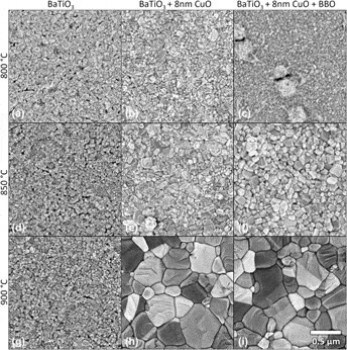
The study, led by Professor Yang Hao from Queen Mary's Centre for Electronics, has been published in Nature Communications. It reveals how the team engineered microscopic structures—called polar nanoclusters—inside a special ceramic film to create materials that can "tune" their electrical behaviour at microwave frequencies used in devices such as 5G antennas, radar systems, and sensors.
Modern communication and sensing technologies depend on materials that can adjust how they interact with signals; changing frequency, reducing interference, or improving sensitivity. Until now, creating materials that could do this effectively and efficiently has been a major challenge.
The Queen Mary team overcame this by precisely controlling the internal structure of a thin ceramic layer. Their method lets the material change its electrical response using less power and with minimal signal loss—something that has long limited previous designs.
"By engineering the material at the nanoscale, we can achieve strong and stable tunability without compromising performance," said Professor Hao. "This opens the door to a new generation of reconfigurable wireless and sensing devices that are faster, smaller and more energy-efficient."
The breakthrough could have far-reaching impact across industries—from next-generation mobile networks and satellite communications to advanced medical imaging and autonomous systems. Devices that can automatically adapt to changing environments are central to the future of sustainable, intelligent electronics.
Beyond practical applications, the findings also offer new scientific insight into how materials behave at the smallest scales, particularly in how tiny polar regions can boost performance at higher frequencies.
The research team is now exploring how to integrate these tunable films into working components and scale up the manufacturing process for real-world use.
Read more at: https://www.nature.com/articles/s41467-025-64642-1
People: Yang HAO Theo SAUNDERS Joe BRISCOE Hangfeng ZHANG Subhajit PAL Haixue YAN
Contact: Akram AlomainyEmail: a.alomainy@qmul.ac.uk
Updated by: Akram Alomainy