


News
July 2026

Queen Mary expert helps shape new Department for Education guidance on screen use in early years settings
Faculty of Science and Engineering
13 July 2026Professor Rachael Bedford, from the Centre for Brain and Behaviour at Queen Mary University of London, helps shape new Department for Education (DfE) guidance on screen use for children in early years settings, ensuring the latest evidence informs practice across nurseries, preschools and childminding settings. Published by the Department for ... [more]

New podcast on the science of musical taste
Centre for Human-Centred Computing
7 July 2026Dr. Marcus Pearce, cognitive scientist at Queen Mary University of London is interviewed in this podcast on why music affects us so deeply—and why those responses differ across cultures. Drawing on insights from his book Learning to Listen, Listening to Learn, Pearce explains how the brain predicts musical patterns, ... [more]
June 2026
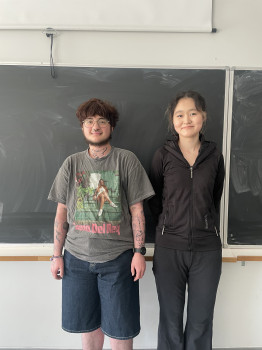
Summer research internships for undergraduate students
Faculty of Science and Engineering
13 June 2026Ten talented undergraduate students from across a wide range of Science and Engineering programmes are embarking on exciting summer research internships under the mentorship of academic supervisors. This fantastic opportunity has been made possible through the QMUL Summer Training Research Initiative to Support Diversity and Equality (STRIDE) and the London ... [more]
May 2026
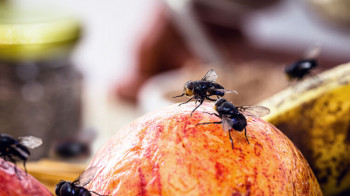
Tiny insect brain discovery offers a blueprint for faster and more efficient AI and robots
Faculty of Science and Engineering
5 May 2026The secret behind insects' lightning fast reactions could offer a blueprint for more energy efficient robots and self-driving cars, according to a new study challenging our understanding of how brains process information. The secret behind insects' lightning fast reactions could offer a blueprint for more energy efficient robots and self-driving ... [more]
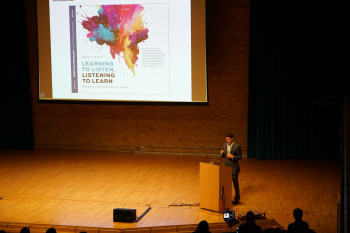
Marcus Pearce delivers keynote address at two conferences
Centre for Human-Centred Computing
4 May 2026Marcus Pearce has delivered two keynote addresses at the Society for Education, Music and Psychology Research (SEMPRE) 2026 conference at the University of Cambridge and at the International Conference on Music and Sleep at Aarhus University, Denmark. These presentations follow the publication of his book Learning to listen, listening to learn ... [more]
April 2026

How touch and emotion combine to shape our memories and relationships
Faculty of Science and Engineering
24 April 2026New paper in Neuroscience & Biobehavioural Review proposes first neurobiological model for how emotionally meaningful touch stays in our memory and influences our connections with others. Why does a comforting touch stay with us for years, while other sensations quickly fade from our minds? A new paper offers a novel answer, ... [more]
February 2026
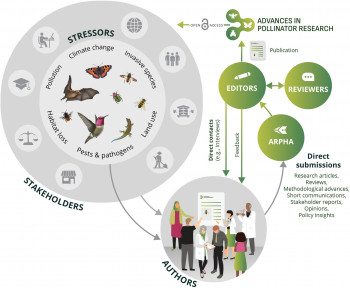
New journal Advances in Pollinator Research launched by Centre for Biodiversity and Sustainability member Rachel Parkinson
Centre for Biodiversity and Sustainability
19 February 2026Pollinators comprise a taxonomically diverse group – including insects, mammals, birds, and more rarely, amphibians, reptiles, and even gastropods – that support wild plant communities and underpin global food production systems. Today, a new journal has been lauched dedicated to the study of this essential ecosystem compoment: Advances in Pollinator Research. CBS ... [more]

Why ADHD is often diagnosed later in women: A conversation with Dr Jessica Agnew-Blais
Centre for Brain and Behaviour
11 February 2026Emily Bates was diagnosed with Attention-Deficit Hyperactivity Disorder (ADHD) at the age of 34. In a recent Nature Outlook programme, Ms Bates reflects on how her symptoms were easy to miss earlier in life - from appearing like a "model student" at school to coping by leaving work until the very ... [more]
Grant on Identification of Sensory-Motor Patterns of Autism
Centre for Human-Centred Computing
1 February 2026Ekaterina Ivanova and Rachael Bedford have been awarded a grant from the QMUL CIRCLE Fund to run a pilot study to identify the Sensory-Motor Patterns of Autism. It runs until the end of 2026, and is worth £7,873.16 The main objective of the project is to investigate differences in interaction motion patterns ... [more]