

Events
Lex Millins - The MIGDAL experiment: Measuring a rare atomic process to aid the search for dark matter
Centre for Theoretical Physics and Astronomy Centre for Experimental Physics and Quantum Technology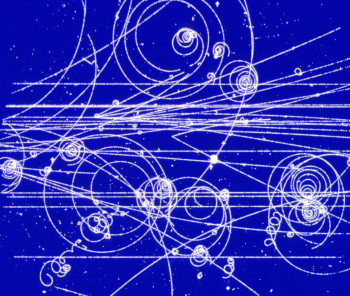
Image Copyright CERN, used with permission: https://cds.cern.ch/record/39474
Date: 18 March 2026 Time: 13:30 - 15:00 
Location: Room 610, GO Jones
Many dark matter experiments are exploiting the Migdal effect, a rare atomic process, to improve sensitivity to low-mass WIMP-like dark matter candidates. Following the recent first observation of the Migdal effect in nuclear scattering [1] the characterisation of the effect and measurements of the cross-section in a range of elements is of great importance to the DM community. The MIGDAL experiment aims to characterise the Migdal Effect in a range of species and test theoretical predictions of the cross-section. This is performed using a low-pressure optical time projection chamber to image in 3-dimensions the characteristic of a Migdal event: an electron and a nuclear recoil track sharing a common vertex. Nuclear recoils are induced using fast neutrons from a DD source, which scatter in the gaseous volume of the detector. The experiment is operated with 50 Torr of CF4 using two glass GEMs for charge amplification. Both scintillation light and ionisation charge are read-out, and these measurements are combined for full-track reconstruction. In this seminar I will present an overview of the experiment along with the results of the analysis of the first search for the Migdal Effect in nuclear scattering of carbon and fluorine from the MIGDAL experiment at the Neutron Irradiation Laboratory for Electronics (NILE) at the Rutherford Appleton Laboratory in the UK.
13:30-14:00 - In person refreshments
14:00-15:00 - seminar
| Website: |
Updated by: Seth Zenz