

News
Queen Mary academic joins £1.4M international network reshaping how music is created, studied and experienced across cultures
Centre for Multimodal AI Centre for Human-Centred Computing Faculty of Science and Engineering22 August 2026



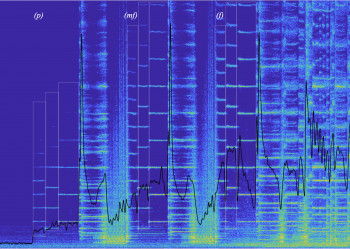
Spectrogram plot of "Sunrise" from Richard Strauss' Also sprach Zarathustra with overlaid spectral centroid contour. (Figure 12.4, Oxford Handbook of Orchestration Studies)
Dr Charalampos Saitis, Assistant Professor of digital music processing at Queen Mary University of London's Centre for Multimodal AI, member of the Centre for Digital Music and Director of the Communication Acoustics Lab, is a co-investigator on a major new international research partnership that sets out to broaden how timbre and orchestration are studied across the world's musical cultures.
Led by McGill University's Schulich School of Music and funded by a CAD $2.5 million (approx. £1.4M) Social Sciences and Humanities Research Council (SSHRC) Partnership Grant, the Timbre and Orchestration Network (TONE) brings together scholars, performers, composers and technologists alongside students in music, psychology and computer science. The initiative aims to expand research and education on two of music's most fundamental yet historically underexamined dimensions beyond their traditional focus on the Western classical canon.
Every sound has a timbre. Often described as the "colour" of sound, timbre is what allows listeners to distinguish between a violin and a human voice playing the same pitch. Orchestration is the art of combining sounds to create musical meaning. Both are central to music-making worldwide, yet have received far less scholarly, scientific and computational attention than pitch and rhythm, which are more easily captured in written notation.
Within TONE, Dr Saitis co-leads (with TONE co-director Prof Stephen McAdams) research on developing computational methods and software for the analysis of timbre and orchestration in both notated and non-notated musics. This work will create new perceptual taxonomies and multimodal classifications to be included in existing or new digital tools, including analyses of traditional, improvised, and electroacoustic musics. It speaks directly to one of the network's core questions: how do you analyse and conceptualise what you hear when there is nothing written down?
TONE comprises a 16-member partnership of 12 universities, four conservatories, three orchestras and a music centre across North America and Europe, drawing in scholars and musicians from 15 countries, including the Global South. The project spans a wide spectrum of practices, from hip hop, jazz and electronic music to Chinese, Turkish, Arabic, Persian, Indonesian and African traditions, bridging music theory, ethnomusicology, psychology, acoustics and technology.
TONE builds on the SSHRC-funded ACTOR (Analysis, Creation, and Teaching of Orchestration) project, which between 2018 and 2025 brought together over 70 researchers across five countries and produced key resources, including the open-access Timbre and Orchestration Resource (TOR) website and the recently published Oxford Handbook of Orchestration Studies. Dr Saitis was a collaborator of ACTOR, through which he won funding to study semantic and multisensory representations of timbre, and was invited to contribute a chapter on these topics.
Where ACTOR focused largely on Western classical traditions, TONE responds to growing calls to decentre Eurocentric approaches and to include improvised, orally transmitted, popular and experimental musics. The grant strengthens Dr Saitis's work at the intersection of music perception, signal processing and multimodal machine learning/AI, and extends Queen Mary's contribution to a global effort to understand music as a shared human phenomenon.
Source and more information: reporter.mcgill.ca/mcgill-led-international-collaboration...
People: Charalampos SAITIS
Contact: Charalampos SaitisEmail: c.saitis@qmul.ac.uk
Updated by: Charalampos Saitis