

Theory and Modelling of Materials
Theory is an essential complement to experiment in the modern physical sciences, helping to explain existing results, interpret experimental data or guide future work; and revealing materials’ behaviour under conditions that preclude experimental observation. We have an active theory and modelling programme, supported by excellent computing facilities both locally and through regional and national Hubs. We use the full range of methods, from highly accurate quantum theory to empirical or machine-learned potentials for vast simulations over large length and time scales.
Current research interests include
- accurate understanding of weak intermolecular interactions, with applications from proteins to graphene;
- highly frustrated systems such as quantum spin liquids, searching for new phases of quantum matter;
- structural, magnetic, and electronic disorder and its effect on materials properties; and
- the fundamental origins of entropy in materials, to selectively stabilise or destabilise particular phases.
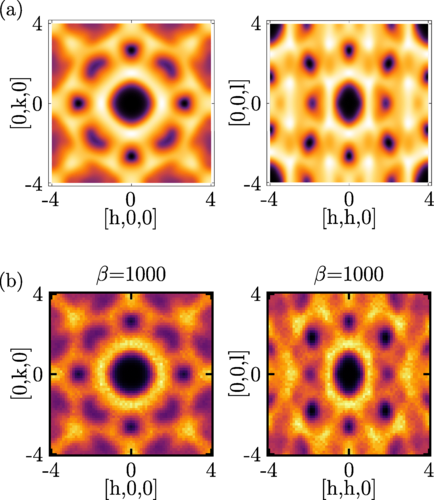
The spin structure factor S(Q) on the trilline lattice, a fragile 3D spin liquid, from (a) approximate theory; (b) Monte Carlo simulation.