

Detectors, Sensors and Semiconductor Devices
Semiconductor detectors and sensors underpin technologies that drive modern society, from healthcare and communications to computing and energy, while also enabling discoveries in fundamental science. This Research Theme brings together expertise in semiconductor materials, optoelectronics, and radiation detection to design, build, and characterise advanced detector technologies and silicon-based devices. The theme is aligned with our Detector Development Group, which develops novel radiation detection technologies for applications ranging from particle and nuclear physics to industry, medicine, and space. For more information and opportunities for collaboration, visit the Detector Development Group webpages.
Using our in-house design, fabrication, and measurement capabilities, we have developed silicon detector technologies for the OPAL experiment at LEP, the ATLAS experiment and the ATLAS Inner Tracker upgrade at the Large Hadron Collider. We are also working on a silicon pixel detector for the upgrade of the Belle II experiment at KEK in Japan. We work with industrial partners to develop organic semiconductor radiation detectors for alpha-particle and neutron detection, and have developed new converter layer fabrication processes for thermal neutron detectors
Our research interests include:
-
organic semiconductors and electronic materials;
-
optoelectronic devices and photonic technologies;
-
radiation detection and advanced sensor systems;
-
semiconductor devices for extreme environments; and
-
device simulation, modelling, and materials characterisation.
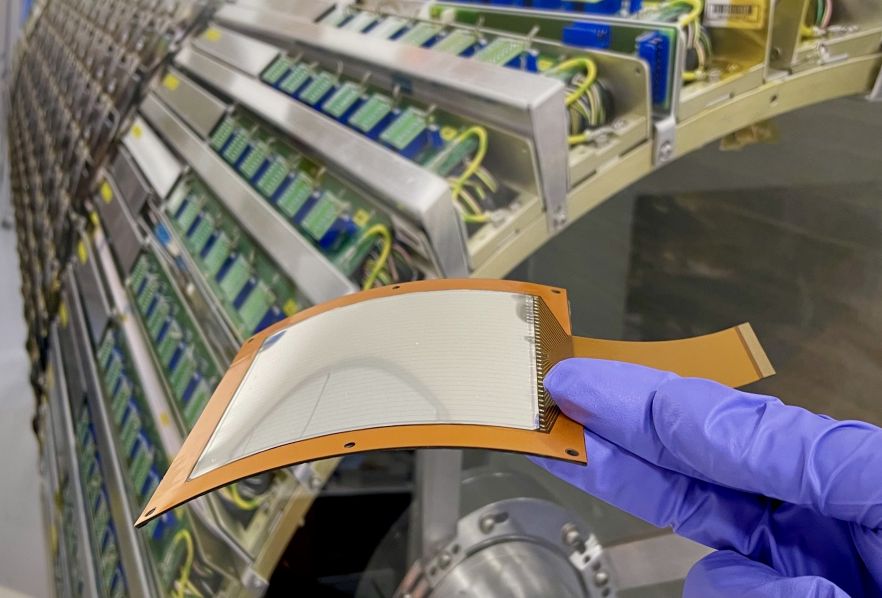 Curved silicon sensor module for particle detection experiments