

News
From biodiversity to artificial intelligence
Faculty of Science and Engineering Centre for Multimodal AI Centre for Probability, Statistics and Data Science16 October 2025


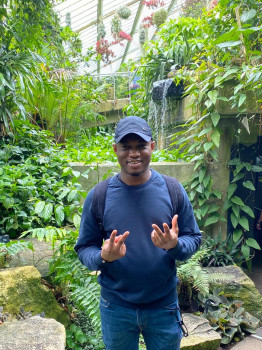
Kabiru at Kew Garden.

David Mguni
We showcase the research work of Kabiru Abubakari, a PhD student in the Centre for Probability, Statistics and Data Science, and the research work of Dr David Mguni, a lecturer in the Centre for Multimodal AI.
Kabiru Abubakari
Kabiru's research focuses on Bayesian spatial modelling for biodiversity.
His PhD project is devoted to developing and applying Bayesian spatial and spatio-temporal modelling techniques to enhance understanding of the association between plant species at risk of extinction and areas in need of protection in the face of climate change, changing land use (especially agriculture), and pollution. Working together with his supervisors — Prof Silvia Liverani (SMS), Prof Andrew Leitch (SBBS), and Dr Ilia Leitch (Royal Botanic Garden, Kew) — Kabiru combines statistical modelling and ecology to develop methods that better capture uncertainty in biodiversity data.
His academic journey began with a degree in Economics at the University for Development Studies (UDS) in Tamale, Ghana, where he graduated in 2020. Since joining Queen Mary, Kabiru has also been very active in supporting students of Black heritage as a tutor in Levelling Up Maths and as a panellist at the Black Heroes of Mathematics Conference.
Read more about Kabiru's research in this poster.
David Mguni
David is a Lecturer in Artificial Intelligence. His research spans reinforcement learning, game theory, and optimal control, with a focus on developing self-improving, cooperative learning systems. His work contributes to a broader vision of building AI that can reason, adapt, and learn autonomously in an open-ended world.
Together with his PhD student Yaqi Sun and master's students, David is working towards one of the grand goals of artificial intelligence: creating systems that can not only learn from existing training data but also learn how to learn and invent their own challenges. The group's research on the Recursive Meta-Learning Framework explores how intelligent systems can evolve their own learning rules and generate and solve new problems that push them beyond the limits of human-derived data.
A central focus of the group's work is reinforcement learning — particularly understanding how multiple intelligent systems can cooperate, compete, and coordinate in open, dynamic environments. The group's research seeks to overcome the limitations of traditional reinforcement learning algorithms by enabling AI to learn the rules of learning itself.
This approach has far-reaching implications. By allowing AI systems to invent new challenges, discover hidden structures, and maintain stability as they learn together, the research moves toward the long-term goal of artificial general intelligence: machines capable of generalising knowledge, adapting creatively, and cooperating safely across domains. Possible applications range from AI programs that autonomously generate novel mathematical proofs to agents that continually refine their understanding of molecular structures for drug discovery.
The group's work blends theory with practical experimentation, drawing on dynamical systems, game theory, category theory, stochastic control, and variational optimisation. These mathematical foundations ensure that the learning mechanisms they develop are not only powerful and flexible but also grounded in principles that make them interpretable, stable, and safe.
To learn more about David's research, read also here.
People: Kabiru ABUBAKARI Silvia LIVERANI David MGUNI Andrew LEITCH
Contact: Claudia GarettoEmail: c.garetto@qmul.ac.uk
Updated by: Claudia Garetto