

News
"This engine is grinding to a halt" - Nature slowing down as climate change gains pace
Centre for Biodiversity and Sustainability9 February 2026


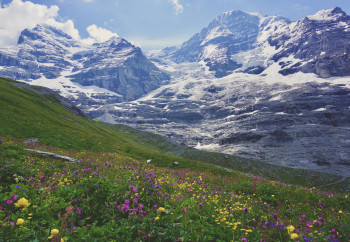
A meadow in the Swiss Alps displaying a rich ecological community of flowers. Photo: Ian McFadden
The Centre for Biodiversity and Sustainability recently uncovered a global ecological paradox.
While it is widely expected that accelerating climate change will speed up nature's pace—forcing species to replace each other more rapidly—we found the exact opposite. By analyzing a century of data across marine, freshwater, and terrestrial ecosystems, we discovered that local species turnover is actually slowing down.
Lead author Dr. Emmanuel Nwankwo uses a striking analogy to explain this: "Nature functions like a self-repairing engine, constantly swapping out old parts for new ones. But we found this engine is grinding to a halt."
The study, published in Nature Communications, suggests that widespread habitat degradation has depleted the "spare parts" of this engine: the regional pools of species capable of surviving in modified ecosystems. Without a diverse species pool to draw from, the internal dynamics of these communities are seizing up, even as climate change accelerates.
Professor Axel Rossberg, co-author of the study, said: "We were surprised how strong the effect is. Turnover rates typically declined by one third."
This research highlights the complex, often counter-intuitive responses of biodiversity to human impact. It is just one example of the diverse research we undertake at SBBS, where we combine fieldwork at sites around the world with data science and theoretical modelling to truly understand life in a changing world.
People: Axel ROSSBERG Ian MCFADDEN
Contact: Axel RossbergTel: 07551 396243
Email: a.rossberg@qmul.ac.uk
Updated by: Axel Rossberg