

News
Queen Mary hosts international PLATO Theory Meeting as ESA's exoplanet mission approaches launch
Centre for Theoretical Physics and Astronomy14 January 2026


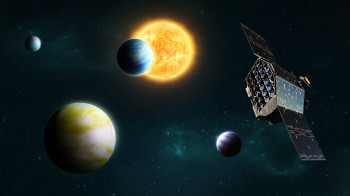
Queen Mary's Astronomy Unit (AU) has just hosted the third PLATO Theory Meeting, bringing more than 70 researchers to Mile End to discuss how the community can make the most of ESA's forthcoming exoplanet mission, PLATO.
The meeting, held from 12–14 January 2026, was organised by the AU's Exoplanets and Planet Formation group and took place in the Mathematical Sciences building. It brought together theorists and observers working across the full breadth of exoplanet science, with a shared focus on turning PLATO's expected discoveries into reliable physical understanding. Researchers came from institutions across Europe and beyond, reflecting the breadth of international interest in the mission.
PLATO, which is scheduled for launch towards the end of 2026, is designed to deliver a large, well-characterised sample of planetary systems, including Earth-sized planets in the habitable zones of Sun-like stars. Its particular strength will be the combination of planet detections with precise stellar characterisation — including masses, radii, ages and orbital architectures — enabling population-level questions about how planets form, migrate and evolve to be addressed with statistical power that has not previously been possible. The mission's expected bounty of thousands of new exoplanets promises to transform our understanding of planetary demographics across the galaxy.
Against that backdrop, the meeting followed a clear narrative arc: from protoplanetary discs and the earliest stages of planet formation, through disc–planet interactions and migration, to mature system architectures, interiors, tides and long-term dynamical evolution. The format deliberately prioritised discussion, with short talks and poster contributions feeding into structured sessions aimed at identifying shared priorities and practical next steps for the PLATO theory community.
The meeting was chaired by Professor Richard Nelson, who leads the Exoplanets and Planet Formation group at Queen Mary. "PLATO represents a once-in-a-generation opportunity to put planet formation theory to the test at scale," said Professor Nelson. "Bringing together the theory community now — before the data arrive — means we can coordinate our efforts, identify the key open questions, and make sure we're in the best possible position to extract the most science from the mission."
The group that organised and hosted the meeting is one of the most active in the UK in the fields of planet formation and exoplanet science. Professor Nelson's own research focuses on the formation and dynamical evolution of planetary systems, including the migration of planets through protoplanetary discs — a key process that shapes the architectures PLATO will observe. Dr Tom Haworth, a Dorothy Hodgkin Fellow, holds a €2m European Research Council Consolidator Grant to investigate how the radiation environments around young stars drive the evolution of planet-forming discs, work that is central to understanding how the diversity of planetary systems we observe ultimately originates. Dr Ed Gillen, a Reader in Astrophysics, was awarded a €1.5m ERC grant to study how planetary systems evolve during their early lives by detecting and characterising young exoplanets — research directly complementary to what PLATO will deliver for older systems. Dr Andrew Winter, a Royal Society University Research Fellow, is investigating how the large-scale star formation environment shapes the properties of exoplanet populations, linking the conditions in which stars are born to the planets they end up hosting.
Together, the group spans the full chain from disc physics and planet birth to the mature systems that missions like PLATO will characterise in unprecedented detail, making Queen Mary a natural home for this kind of community-wide planning meeting.
For QMUL, the meeting underscored both the strength of the Astronomy Unit's planets programme and its capacity to convene and lead international scientific activity. Further details, including the full programme, are available on the meeting webpage.
People: Richard NELSON Thomas HAWORTH Edward GILLEN Andrew WINTER
Updated by: Christopher Chen