

News
Welcome to Our New Postdocs
Centre for Combinatorics, Algebra and Number Theory6 October 2025


Himanshi Chanana and Patience Ablett
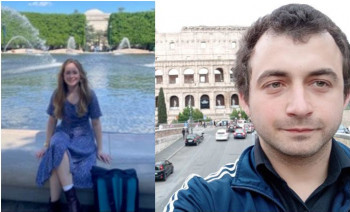
Miriam Norris and Dante Luber
We welcome a bumper cohort of postdocs to the Centre for Combinatorics, Algebra and Number Theory this year. For this post, we asked them to introduce themselves and say a bit about their mathematical journey to QMUL and what they will be getting up to during their time here.
Himanshi Chanana
Hello, I am Himanshi Chanana, a postdoctoral researcher in mathematics at QMUL. I am originally from India and recently completed my PhD at the Indian Institute of Technology Kanpur, where I worked under the supervision of Prof. Saurabh Kumar Singh. My research lies in analytic number theory, an area of mathematics that seeks to understand deep questions about prime numbers. A famous example is the Riemann Hypothesis, which predicts hidden patterns in the distribution of primes. While my work does not directly address this problem, it contributes to the broader picture by studying automorphic forms and L-functions — central objects that are closely connected to many important questions in number theory.
At QMUL, I am working on the project titled "Moments of Higher Rank L-functions" under the guidance of Subhajit Jana. Roughly speaking, this involves studying the average behaviour of L-functions. This often reveals surprising arithmetic insights connected with major conjectures such as the Generalized Lindelöf Hypothesis and subconvexity bounds. Right now, I am particularly focused on studying automorphic forms from a representation-theoretic viewpoint. I am excited to learn new techniques, explore different perspectives, and collaborate with others in this area.
Patience Ablett
Hi! I'm Patience, and I work in combinatorial algebraic geometry. During my PhD I got hooked on toric varieties, a special class of algebraic varieties whose geometry can be understood via combinatorics. During my time at QMUL I'll be continuing my work in this area with Alex Fink, as well as branching out into some matroid theory.
Miriam Norris
I am a representation theorist whose work lies in the intersection between algebra and number theory. After completing an undergraduate degree at the University of Edinburgh I joined the London School of Geometry and Number Theory. I graduated from Kings College London with a PhD in 2022 under the supervision of Prof Fred Diamond and Prof Martin Liebeck. Since then, I have been a research fellow at the University of Manchester and now QMUL where I will be working with Shu Sasaki.
I am interested in representations of algebraic, p-adic and related finite groups. Specifically, I am interested in the aspects of representation theory involved in the Langlands programme. This programme aims to bridge two distinct areas of maths, harmonic analysis (automorphic forms) and number theory (Galois representations). The discovery of such `bridges' has proved extremely valuable with a notable example being part of Andrew Wiles' proof of Fermat's Last Theorem.
Robin Bartlett
I recently moved from Glasgow to take up an MSCA fellowship at QMUL where I will be working with Shu Sasaki. My academic work sits at the interface of representation theory and geometry: I study how representation-theoretic patterns can be realised inside geometric objects that arise in the Langlands program. In this project I'm particularly excited to explore new connections to geometric representation theory, and am looking forward to collaborating across the group. Outside of mathematics I enjoy painting and reading, which helps me take a step away from research and return to problems with a fresh viewpoint.
We wish all of the new postdocs an extremely productive and enjoyable time at Queen Mary, and look forward to being part of the next steps in their mathematical careers!
You can find more about them and their work on their websites:
People: Alex FINK Shu SASAKI Subhajit JANA
Updated by: Saritha Divakar