

News
Evidence for a new Higgs boson decay
Centre for Theoretical Physics and Astronomy Centre for Experimental Physics and Quantum Technology8 December 2025


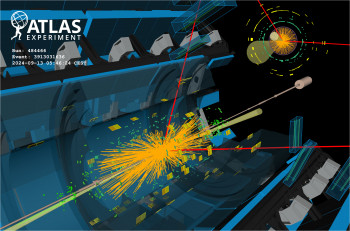
Visualisation of a Higgs to two muons candidate event in the ATLAS detector. Reused under the terms of the Creative Commons Attribution 4.0 International license.
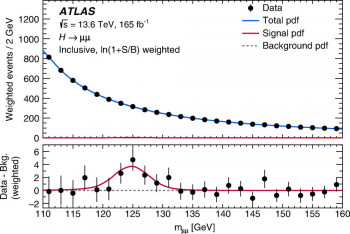
Higgs to two muons mass peak as observed by the ATLAS Collaboration. Reused under the terms of the Creative Commons Attribution 4.0 International license.
Physicists at Queen Mary University of London (QMUL), together with international collaborators, have found evidence of the decay of Higgs bosons to muons. Muons are particles typically found in cosmic rays and have a low mass, and because of this the Standard Model of particle physics predicts that this decay is very rare. Because of this, this new result offers a unique test of the predicted properties of the Higgs boson: so far this decay is every bit as rare as expected, but now that it has been seen the team is working toward further detailed measurements. The ultimate goal is to find discrepancies between the Higgs and predictions, which would provide clues to new theories Beyond the Standard Model of particle physics.
The article, "Evidence for the Dimuon Decay of the Higgs Boson in pp Collisions with the ATLAS Detector" was published in Physical Review Letters, one of the most distinguished journals in the field. The significance of this evidence and the strength of the analysis earned the paper a Viewpoint selection by the journal's editors, a distinction awarded to only around 0.2% of its published articles. This recognition highlights both the scientific importance of the measurement and the impact of the collaborative contributions that made it possible.
At the Particle Physics Research Centre at QMUL, a dedicated team worked with international collaborators on the ATLAS experiment at the Large Hadron Collider. The QMUL team contributed key advances that strengthened ATLAS's sensitivity to the Higgs decay into two muons. Led by academics Dr Ulla Blumenschein and Dr Seth Zenz, together with Dr Christos Vergis and PhD student Arnav Avad, the group focused on improving analyses of Higgs production associated with W and Z bosons. The team refined the analysis through updated event selections, improved background-rejection strategies, and advanced AI techniques that enhanced the discrimination between signal and background. They developed a novel search channel in which the Higgs is produced with a Z boson that decays invisibly into neutrinos, extending ATLAS's reach into previously unexplored territory. These QMUL-driven innovations sharpened the precision of this measurement, enabling the Higgs decay to muons to be identified.
For the researchers involved, the motivation behind this effort is both scientific and personal. As Dr Blumenschein notes, confirming the Higgs–fermion interaction beyond the third generation remains a central question: "So far we have confirmed the Higgs interaction with fermions only for third-generation fermions. The Higgs might still be a Beyond the Standard Model Higgs that does not interact with the first two generations. So it is very important to check whether it couples to second-generation fermions as expected from the Standard Model."
For Arnav Avad, the project has been as much about discovery as it has been about growth. Working on the Higgs to dimuon analysis exposed him to reconstruction tools, machine-learning methods and even hands-on hardware responsibilities within the ATLAS experiment. As he explains, "I enjoy exploring different methods and tools that help us identify the Higgs boson more clearly when it decays into two muons. QMUL has a close, supportive community where everyone works together to contribute to the ATLAS experiment." Reflecting on his own highlights, he adds, "Publishing a paper in PRL where I made major contributions is very fulfilling… being part of an institution that allows me to review papers and provide feedback is equally enjoyable, as it ensures that all research released to the public from ATLAS meets the highest standards."
The QMUL team is already working on further refinements and new analysis techniques, which will enable even more precise tests of the 2nd generation Higgs interactions in the Standard Model.
People: Ulla BLUMENSCHEIN Seth ZENZ Christos VERGIS
Contact: Seth ZenzEmail: s.zenz@qmul.ac.uk
Updated by: Seth Zenz