

News
Rethinking hearing aids: £607k award for innovative research at Queen Mary
Centre for Multimodal AI5 June 2026


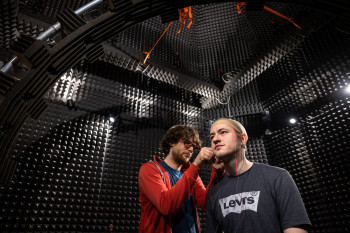
Dr Aidan Hogg and Dr Johan Pauwels conducting a spatial hearing experiment.
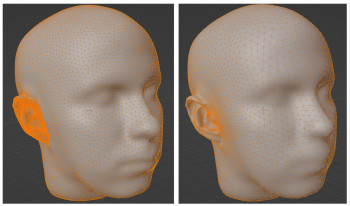
Example of a 3D ear mesh used in spatial-hearing research.
Dr Aidan Hogg, Lecturer in Computer Science at the School of Electronic Engineering and Computer Science, has been awarded a prestigious £607,233 Engineering and Physical Sciences Research Council (EPSRC) New Investigator Award to lead a new project rethinking hearing assistive technology.
The three-year project, Spatial Hearing Augmentation to Improve Hearing Assistive Technology, will begin in September 2026. Based in the Virtual, Immersive, Augmented & Binaural Audio Lab within the Centre for Digital Music, it brings together collaborators from Imperial College London and industry partner Eargym Ltd.
Rethinking how hearing aids work
The project explores a new approach to hearing technology by focusing on how spatial cues can be restored and enhanced, rather than simply suppressing noise or amplifying sound.
Spatial hearing - the ability to locate sounds and follow conversations in complex environments - is often degraded by current hearing aids. This project instead investigates how these cues can be improved to help users better interpret and navigate their surroundings.
A novel AI-driven approach
The research will develop advanced auditory filters known as head-related transfer functions (HRTFs), which describe how sound is shaped by the head and ears. Using machine learning and auditory modelling, the team will design enhanced or "superhuman" HRTFs that exaggerate spatial cues to make them easier to use.
Through behavioural experiments and perceptual training, the project will test whether users can adapt to these enhanced cues and whether this leads to improved sound localisation and speech understanding in noisy environments. It will also create what is believed to be the first open-access dataset of enhanced HRTFs derived from virtual ear shapes.
Impact and significance
EPSRC New Investigator Awards are highly competitive and support outstanding early-career researchers in establishing independent research programmes. The project addresses an important and underexplored challenge in hearing technology, shifting the focus from restoration to perceptual augmentation.
If successful, the research could help people with hearing loss better locate sounds, follow conversations in noisy environments, and feel more confident in everyday situations - areas where current hearing aids often fall short. It may also influence future assistive listening devices and augmented reality audio systems.
Looking ahead
The project is expected to begin in September 2026, with early work focusing on building research infrastructure and developing the enhanced HRTF dataset. Later stages will explore optimisation for real-world listening tasks and user adaptation through training. A postdoctoral researcher will also be recruited.
To find out more, visit Aidan Hogg's website, the VIABAL lab, or the Centre for Digital Music. Information on the EPSRC is available.
People: Aidan HOGG
Contact: Aidan HoggEmail: a.hogg@qmul.ac.uk
Updated by: Aidan Hogg