

News
What is the two-dimensional shadow of a four-dimensional fractal?
Centre for Complex Systems20 August 2026


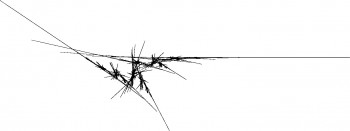
A two-dimensional shadow of a four-dimensional fractal.
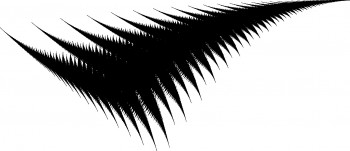
Another two-dimensional shadow of the same four-dimensional fractal.
Ian Morris, Reader in Mathematics in the Centre for Complex Systems, and Çağrı Sert from the University of Warwick, have found a remarkable generalisation of a landmark result about self-affine fractals to their projections or "shadows". Their study, entitled Projections of self-affine fractals, was published in the highly prestigious journal Inventiones Mathematicae.
Broadly speaking, a fractal is a geometric shape of infinite detail. As one zooms in, finer and finer structures emerge, which are often similar to the shape's appearance at larger scales. The most familiar examples are self-similar sets, such as the Sierpiński triangle, the Menger sponge and the von Koch snowflake. An important characteristic that quantifies the complexity or "roughness" of a fractal is its dimension. By definition, every self-similar set is the union of finitely many re-scaled and re-oriented copies of itself. When these smaller copies do not substantially overlap one another, the dimension of the fractal satisfies a well-known formula found by J.E. Hutchinson in 1981.
Much less well understood, and a topic of active research, is the class of self-affine sets. These are sets which are equal to the union of finitely many linearly distorted copies of themselves. Probably the best-known example of a self-affine set is the Barnsley fern. In their breakthrough study, Morris and Sert characterise the dimension of projections of high-dimensional self-affine fractals onto lower-dimensional spaces. For example, they ask for the dimension of the shadow cast by a four-dimensional fractal on different two-dimensional spaces. The dimension of this shadow can vary depending on the angle, just like for ordinary objects: A coin has a one-dimensional shadow when viewed edge-on, but has a two-dimensional shadow when seen from other directions.
Morris and Sert find that self-affine fractals in high-dimensional spaces can cast unexpectedly small shadows. Their work also has connections with dynamical systems and additive combinatorics, showing that observations of chaotic dynamical systems can follow statistical limit laws which are surprisingly unevenly distributed, and that self-affine fractals can have unexpectedly small sumsets.
Link to the original research article: I. D. Morris and C. Sert, Projections of self-affine fractals, Invent. math. (2026)
People: Ian MORRIS
Contact: Lennart DabelowEmail: l.dabelow@qmul.ac.uk
Updated by: Lennart Dabelow