

News
Scientists and leading dance institutions discover a better way to teach dance online
Faculty of Science and Engineering16 September 2026


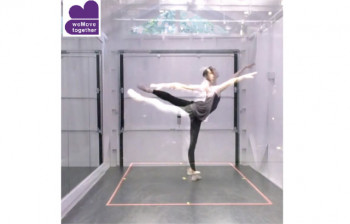
From ballet studio to behavioural science: researchers uncover the best view for learning choreography.
New research from Queen Mary University of London finds that less experienced dancers learn choreography more effectively when they follow a teacher's movements from the same perspective, with implications far beyond dance.
A groundbreaking study led by researchers at Queen Mary University of London has revealed that how dancers view their instructor can significantly affect how well they learn choreography, offering important new insights for dance education, online learning, sport and rehabilitation.
The research, published in PLOS One, was conducted in collaboration with The Royal Ballet School, The English National Ballet School, the Trinity Laban, and academic partners in the UK, Ireland, Denmark and Australia.
By combining psychology, movement science, digital technology and professional dance expertise, researchers found that less experienced dancers performed significantly better when learning choreography from a "back view" perspective, allowing them to follow a teacher's movements directly, rather than watching an instructor face-to-face and having to mentally translate left and right movements.
The findings provide some of the first robust scientific evidence on an issue that affects millions of people learning movement-based skills through classes, videos and online platforms.
Re-thinking how movement is taught
Whether learning ballet, fitness exercises, sport techniques or rehabilitation movements, people are often taught by instructors facing them. However, the new research suggests that this traditional approach may place additional cognitive demands on learners.
The study tested 32 dancers with varying levels of experience, who learned the same choreography through different viewing perspectives. Performance was assessed independently by dance experts using a specially developed digital evaluation platform.
Researchers found that the first-person "back view" consistently produced better results in movement accuracy, spatial awareness and rhythmic performance, particularly among less experienced dancers.
Lead researcher Doctor Elisabetta Versace, from Queen Mary's Centre for Brain and Behaviour, said:
"Dance is a fascinating way to understand how people learn complex movement sequences. Our findings suggest that the perspective under which how movements are demonstrated can reduce cognitive effort and improve learning, particularly for people with less expertise. While the study focused on dance, the implications extend to many activities that involve learning physical skills."
Co-lead researcher Dr Manuela Angioi, from Queen Mary's William Harvey Research Institute, added:
"Online learning and video-based instruction have become increasingly important across education and training. Understanding how visual perspective influences learning can help teachers, coaches and practitioners design more effective ways of teaching movement."
Science meets dance
The research formed part of a wider interdisciplinary collaboration bringing together scientists, dancers, choreographers, educators, physiotherapists and computer scientists.
The project's artistic strand was led by choreographer and former Royal Ballet dancer Erico Montes, who created an original choreography specifically designed for both scientific study and artistic performance. The choreography was developed to fit within a 1.5-metre square space, making it practical even during periods of social distancing and remote learning.
The collaboration involved leading dance educators and institutions including The Royal Ballet School, English National Ballet School and Trinity Laban.
Developing technology for evidence-based dance education
Alongside the scientific findings, the project produced weMove, a free digital platform that allows teachers, researchers and performers to analyse and assess movement performance through synchronised video comparison and expert feedback.
The platform builds on Queen Mary's MotionPerfection technology and enables users to provide structured annotations and performance assessments while comparing different interpretations of the same movement sequence.
The publicly available platform can be accessed at:
https://www.wemovetogether.uk/
A wider story of science, arts and medicine
The research paper represents one part of a much broader programme supported by the Economic and Social Research Council (ESRC), Research England, and Queen Mary's Impact Fund.
The project has also produced educational resources, artistic outputs and a documentary showcasing how collaborations across science, arts, medicine and technology can address real-world challenges in teaching and learning.
A documentary highlights the partnership between universities, vocational dance schools and creative practitioners, demonstrating how interdisciplinary research can deliver both artistic innovation and evidence-based improvements in education.
Watch the documentary: https://www.youtube.com/watch?v=iunDr1_lYKo
Funding
This research was supported by the Economic and Social Research Council (ESRC), The Royal Society, Research England, and Queen Mary University of London's Impact Fund.
Read the full paper here: https://doi.org/10.1371/journal.pone.0355860
People: Elisabetta VERSACE
Updated by: Laura Shepherd