

News
Jan Mol wins Royal Academy of Engineering Research Chair in scaling graphene quantum electronics
Centre for Experimental Physics and Quantum Technology21 September 2026


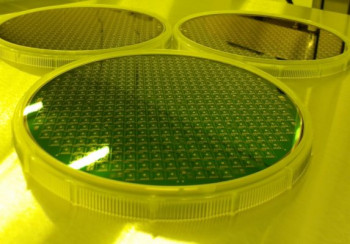
Wafer-scale graphene quantum electronics.
We're delighted to share that Professor Jan Mol has been awarded a Royal Academy of Engineering Research Chair in scaling graphene quantum electronics. The award recognises Jan's pioneering research and will support his work at Queen Mary to develop scalable graphene-based hardware for the next generation of quantum computers.
Quantum computers have the potential to tackle some of the most computationally complex problems, beyond the reach of even the most advanced supercomputers today. Building these computers requires innovation at all levels, including materials and hardware components. The Royal Academy of Engineering Research Chair will enable Jan Mol to drive innovation in one specific area: using the unique material properties of graphene to scale quantum computing hardware performance.
Graphene consists of a single layer of carbon atoms, which makes it an extraordinarily thin, strong, and conductive material. However, graphene is difficult to manufacture, and most quantum electronics experiments rely on small flakes of graphene that are peeled from a graphite substrate, an approach that can never be scaled. Jan will address this scalability challenge by developing quantum electronics hardware using graphene that is manufactured using a standard semiconductor process.
Jan will work in an important partnership with Paragraf, the world's first company able to manufacture graphene at wafer scale using conventional semiconductor tools. Together with Paragraf, Jan will optimise the graphene manufacturing process for device performance at the extremely low temperature of a few millikelvin at which the quantum processing units of quantum computers operate.
The significance of this work lies in its potential to address some of the technical challenges that stand in the way of large-scale quantum computing. Large-scale quantum computers are rapidly becoming a reality, but there are still many challenges that need to be resolved. The electronic components that Jan develops with Paragraf could help to address the wiring bottleneck, getting enough signals to and from the quantum processing units that operate at extremely low temperatures, which needs to be overcome for any useful quantum computation.
Scaling graphene quantum electronics is only the first step. Adoption and deployment by end-users who build quantum computers is the real challenge. Over the coming years, Jan is most excited about building partnerships with full-stack quantum computing companies, hardware vendors and systems integrators, and seeing graphene electronics become an integrable part of their supply chains.
Congratulations to Jan on this fantastic achievement. We're excited to see how his research helps advance graphene quantum electronics.
Updated by: Jan Mol