

News
New European Study Reveals Methane Emissions from Biogas Plants Are Higher Than Previously Estimated – But Most Could Be Easily Reduced
Faculty of Science and Engineering Centre for Sustainable Engineering27 May 2026


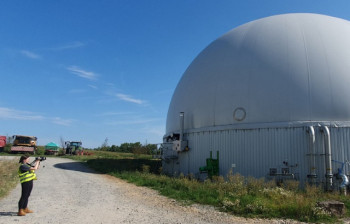
Dr Maria Olczak surveys biogas tanks
A major new study led by Queen Mary University of London has revealed that methane emissions from biogas plants across Europe are higher than some estimates suggest—yet, once identified, the majority of these emissions could be eliminated at no net cost.
A biogas plant is a facility that turns organic matter or material – such as food scraps, manure, sewage sludge or agricultural residues – into renewable energy. Biogas, containing approximately 50–65% methane, can be used to produce electricity and heat via Combined Heat & Power (CHP). Upgraded biogas, containing over 90% methane (biomethane), is typically injected into the existing gas grid and can be used as a substitute for fossil gas. This offers substantial low-carbon energy potential, but uncertainties regarding methane emissions may undermine this benefit.
Published in Nature Communications Sustainability, the research presents one of the most comprehensive assessments to date of methane emissions from biogas and biomethane production. It combines detailed emissions measurements, environmental assessments, mitigation analysis, and comparisons of policy frameworks across Europe. The research team included colleagues from Queen Mary University of London, the Royal Holloway University of London, Heidelberg University, and AGH University of Krakow.
Led by Maria Olczak during her PhD candidacy at Queen Mary, and Paul Balcombe, Professor of Chemical Engineering and Renewable Energy, the researchers measured methane emissions at biogas plants in the UK, Poland and Germany. On average, each plant was losing about 14.4 kilograms of methane every hour, meaning that for every 100 units of methane the plants produced, around 5 units were leaking into the atmosphere instead of being used as energy.
However, the study shows that these emissions are highly variable. The lowest-emitting sites were losing only about 1.3 kilograms per hour, while the highest, recorded during abnormal operating conditions, were leaking up to 57 kilograms per hour. In percentage terms, this means some plants were losing just 2% of what they produced, while others were losing as much as 22%.
Crucially, the team found that 59% of these emissions could be eliminated at no net cost, and 83% could be mitigated overall, using measures already available to industry, such as using gas-tight digestate storage tanks and regular Leak Detection and Repair surveys.
Professor Paul Balcombe said: "Preventing methane emissions must be a priority as the biomethane sector grows. Cost-effective mitigation is widely available, particularly for new plants where best practices can be embedded from the start."
The study uncovered several unexpected findings:
- Methane reduction is even more critical for plants producing electricity via Combined Heat & Power (CHP) than for those injecting biomethane into the gas grid. Methane accounted for 47% of emissions in CHP scenarios, compared with 30% for biomethane injection.
- More frequent leak detection and repair (LDAR) surveys do not automatically lead to lower emissions. Equipment quality and operator expertise were found to be more important, with key implications for regulators.
- Operators' ability or willingness to reduce emissions is influenced by factors including business models, feedstock types, stability of subsidy schemes and the volume of gas captured and sold.
The study comes at a crucial moment for European energy and climate policy. The EU's REPowerEU plan aims to scale biomethane production to 35 billion cubic metres per year by 2030, up from 4.1 bcm in 2024 across the EU. Without strong emissions management, this rapid growth risks undermining the climate benefits of biomethane.
The results also offer timely evidence for the European Commission as it revises the Renewable Energy Directive's Annex V and Annex VI—key components that define how greenhouse gas emissions from biomethane are calculated.
The research breaks new ground in several ways:
- It provides the first source-level methane measurements for biogas plants in Poland and the UK, enabling identification of specific emission points rather than general site-level estimates.
- Poland and the UK hold some of Europe's highest potential for future biomethane production, making emissions reductions in these countries especially critical.
- The study integrates:
- source- and site-level measurements
- detailed emissions reconciliation
- environmental assessment
- techno-economic assessment of mitigation options
- cross-country policy analysis
First author and lead researcher on the study, Dr Maria Olczak said: "We would like to thank all the operators who supported this study. It was particularly encouraging to see operators act on our findings, demonstrating the practical value of this research."
The research was conducted independently by teams at Queen Mary University of London, Royal Holloway University of London, Heidelberg University, and AGH University of Krakow, with cooperation from plant operators. It was not funded by biogas or biomethane industry associations.
Read the paper on Nature Communications here: www.nature.com/articles/s44458-026-00065-3
People: Paul BALCOMBE
Updated by: Laura Shepherd