

News
Queen Mary hosts UKAN meetup on spatial acoustics and immersive audio
Faculty of Science and Engineering Centre for Multimodal AI24 November 2026


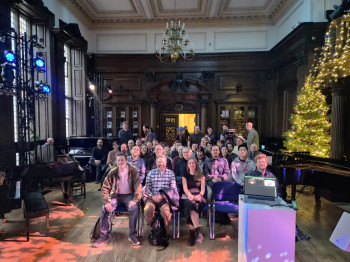
Participants at Yamaha Music London during the UKAN Spatial Acoustics and Immersive Audio SIG meetup on 24 November 2026.
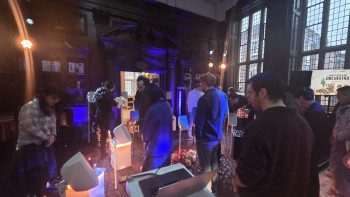
Participants exploring the interactive How To Build An Orchestra installation at Yamaha Music London.
Queen Mary University of London hosted the UK Acoustics Network (UKAN) Spatial Acoustics and Immersive Audio Special Interest Group meetup on 24 November 2026, bringing together researchers, students and industry practitioners for research talks, discussion and demonstrations.
Organised by Dr Aidan Hogg, co-lead of Queen Mary's Virtual, Immersive, Augmented and Binaural Audio Lab (VIABAL) and a member of the Centre for Multimodal AI and Centre for Digital Music, the event attracted nearly 40 registrations, including around 15 PhD students.
Sharing research across the spatial audio community
The meeting began at Queen Mary's Mile End campus, with talks covering hearing diversity, personalised spatial audio, loudspeaker system design, sound field analysis and room acoustics simulation. Speakers represented the universities of Cambridge, Surrey and Southampton, King's College London and Queen Mary, alongside independent practice.
Queen Mary contributions included Rashad Al-Dahiri's research on generating individualised head-related transfer functions using geometric models of the outer ear, and Yuke Liu's preliminary work on benchmarking world models' spatial audio capabilities.
Other presentations explored the Aurora3 loudspeaker arrangement, perceptually driven optimisation of spatial audio, and tools for authoring immersive sound environments.
Exploring an interactive orchestra at Yamaha Music London
In the afternoon, participants visited Yamaha Music London in Soho for a Sound xR session hosted by Tom Rundle. The visit included a demonstration of How To Build An Orchestra, an interactive installation created by Yamaha in partnership with the London Symphony Orchestra.
Using a recording of Tchaikovsky's The Nutcracker, conducted by Sir Simon Rattle, the installation allows visitors to explore the orchestra by activating the string, woodwind, brass and percussion sections individually or combining them into a complete performance. Yamaha's Sound xR Image technology and a spatial arrangement of loudspeakers recreate the positions of the orchestral sections within the room.
Participants experienced how spatial audio can support an interactive musical experience in a compact space, connecting the day's research discussions with a practical application in public engagement and music education.
The organisers thank all speakers and participants for their contributions, and Tom Rundle and the Yamaha team for hosting the afternoon session.
People: Aidan HOGG
Contact: Aidan HoggEmail: a.hogg@qmul.ac.uk
Updated by: Aidan Hogg