

News
Queen Mary PhD student wins Best Student Paper Award at ISMIR 2026 for AI research on piano performance
Faculty of Science and Engineering Centre for Multimodal AI12 November 2026


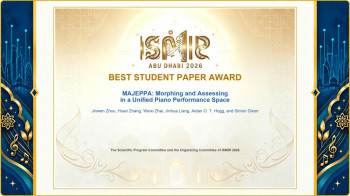
ISMIR Best Student Paper Award
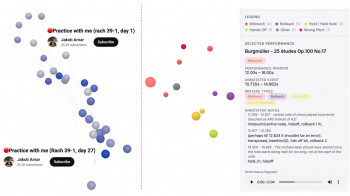
MAJEPPA Embeddings
Jinwen Zhou, a PhD student in the School of Electronic Engineering and Computer Science at Queen Mary University of London, has received the Best Student Paper Award at the 27th International Society for Music Information Retrieval Conference (ISMIR 2026), held in Abu Dhabi, UAE, from 8–12 November 2026.
The award recognises the paper MAJEPPA: Morphing and Assessing in a Unified Piano Performance Space, which introduces a new artificial intelligence framework that can both generate and understand piano performances across different levels of musical ability.
Led by Jinwen Zhou and Huan Zhang, the research was conducted in collaboration with Weixi Zhai, Jinhua Liang, Professor Simon Dixon and Dr Aidan Hogg. The work brings together expertise in machine learning and music information retrieval within Queen Mary's Centre for Digital Music.
Teaching AI to understand how music is performed
Playing the correct notes is only one aspect of a musical performance. Two pianists can perform the same piece very differently depending on their experience, technique and musical expression.
While existing AI models are often trained on professional recordings, they can struggle to capture the full range of human musical performance, from a beginner practising a piece for the first time to a professional pianist performing on stage.
To address this challenge, the researchers developed MAJEPPA, a self-supervised machine learning framework that learns the relationship between a musical score and how that score is performed.
The team assembled a dataset of nearly 4,000 annotated piano recordings spanning six levels of expertise and six recording contexts, including practice sessions, demonstrations and concert performances.
Using this dataset, MAJEPPA learns representations of musical performances that capture aspects of playing style, accuracy and expressiveness. The model can also generate different interpretations of a musical score, conditioned on the performer's experience level.
Towards more intelligent music education tools
A key contribution of the research is its ability to support both music generation and performance assessment within a single AI framework.
The researchers introduced a new evaluation benchmark to test how effectively the model understands different aspects of piano playing, including performance quality, competition ranking, playing mistakes and technique classification.
The results demonstrate the potential of learning representations that capture not just which notes are played, but how they are performed.
This approach could contribute to future intelligent music education systems that provide more personalised feedback, help learners identify mistakes and support the development of musical technique.
International recognition
ISMIR is a leading international conference that brings together researchers working at the intersection of music, artificial intelligence, and signal processing.
The Best Student Paper Award recognises outstanding student-led research presented at the conference.
The award is a significant achievement for Jinwen and her collaborators, highlighting the strength of music AI research at Queen Mary University of London.
Congratulations to Jinwen and the entire research team on this fantastic achievement!
Find out more
Explore the interactive MAJEPPA demonstration
People: Aidan HOGG Simon DIXON
Contact: Aidan HoggEmail: a.hogg@qmul.ac.uk
Updated by: Aidan Hogg