

Shaping Greener Urban Transport
Intelligent transportation systems (ITS) use sensors, communications, data analytics, and AI to improve transport safety, efficiency, reliability, and sustainability. Over the past five years, our research at Queen Mary University of London has focused on resilient and robust ITS perception, centred on two pillars: Smart Roads and Smart Vehicles.
For Smart Roads, traditional sensors, such as cameras and LiDAR, face challenges including adverse weather conditions, limited range, and privacy concerns. We address these through Distributed Acoustic Sensing (DAS), which uses buried optical fibres to continuously monitor traffic over distances of up to 50 km. DAS is energy-efficient, resilient to poor conditions, and inherently privacy-preserving. A real-world testbed in East London, developed with T2Sensing, supports validation under live traffic.
For Smart Vehicles, our EU-funded ROADVIEW project studies how adverse weather degrades sensor data. The SPRING group at QMUL developed validated sensor noise models and digital twins, integrated into the CARLA simulator, to improve AI robustness, perception, and testing in extreme conditions.
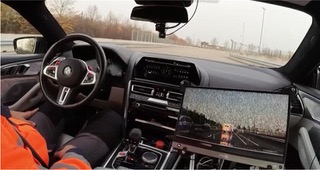 Testing driverless technology
.png) East London Smart Road Testbed
East London Smart Road Testbed- More information: Centre for Intelligent Transport & Centre for Networks, Communications and Systems
- Contact: Prof. Valentina DonzellaDr. Mona Jaber